 My journey north takes me around Death Valley, and into the Pahrump area. The area is empty of people, with only a few small settlements about. But there is a rich history, of which many bits remain standing in the dry desert air, if you are willing to head out and explore parts unknown. Join me in my explorations to see what I found.
 I was driving north out of Baker on California Highway 127, heading towards Death Valley. You will definitely want to start with a full tank of gas in Baker, as the only place to fill up anywhere near to Death Valley is in Shoshone, a little town with limited supplies and expensive gas. But if you low on gas, expensive gas is still way better than no gas. I was not visiting Death Valley itself – that is a National Park, of which I’m not paying to see more desert that is all around me for free. Yes, it has some unique features, but it’s not enough to make me pay just to be in the lowest spot in the Americas. I was meeting up with Carolyn, of Carolyn’s RV Life, who had been hanging around the area for most of the winter. My winter of socializing was continuing, having spent what felt like half my time with other people so far this winter. Camping with Carolyn is kinda like camping off on your own half the time. Running a YouTube channel is a full time job at least if you want to make any money off of it. She was working most days and I was off exploring while we camped together.
 Carolyn had found a spot on the edge of Death Valley National Park, beside what I can only term as “mystery pavement”. It was just a long straight stretch of pavement, not connected to anything more than a cart path road. There was no other infrastructure. At 475m long, it’s too short for a runway. It had a few faint markings left on it, looking like random highway lines painted on it. My best guess is that is was a pavement test strip, but who knows. It did make for a good boondocking spot, if a little close to the highway. You could see signs of camping on both ends of the strip, with a few people camped off a ways on the opposite end we were on. I did a couple of hikes around the area which had some varied rock forms and easy to climb hills for a nice view looking back the way I had come from Baker.

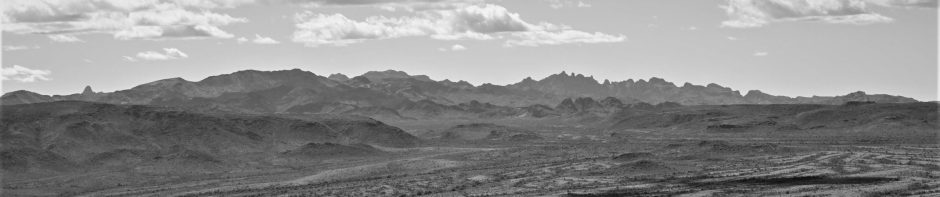
California Valley has a view to the Spring Mountains of Nevada
We moved on with her needing to dump and get water. One benefit of traveling with other experienced boondockers is the shared knowledge of the area. Carolyn got water and dumped in Tecopa, in a “campground”. I say that in quotes as it really is a few spots lined up beside the road. Blink and you’ll miss it. But you can use a spot to get rid of your sewage and fill up with water for a reasonable price. I would never have found this spot on my own, although it is now listed on iOverlander. She had a spot in mind to boondock in the California Valley, a middle of nowhere area south of Pahrump on a road that wasn’t even on most maps. In fact, I had to add it to my Michelin Road Atlas, as it’s a missing connection that is quite useful heading from Death Valley to Vegas. Yes, I still like using a paper map to browse for potential destinations. There is something about a paper map’s presentation that reveals potential destinations a googles, apples, or bing maps browse just will not show.
 The road is a part of the Old Spanish Trail system, a group of routes that evolved over seasons and time as a way from Santa Fe to Los Angeles. The area is little changed from the time of the Old Spanish Trail. I took a ride on the motorcycle down the one gravel road traveling up the California Valley. I saw the remains of one watering hole for livestock, there may have been a farmstead here at one time too, but nothing I could see remained. I had already traveled quite a ways up the valley. The road eventually swings back towards Tepoca, with no further signs of human footprints beyond the usual mine scars. Those are virtually everywhere in the desert. I’ll guarantee this area had fewer people in it than most of Death Valley proper, with this not being a National Park.

Common Side-blotched Lizard
 We proceeded onto Pahrump, planning to meet at Carolyn’s Patreon group get together. She does these once in a while for higher tiered members. It was my first time in Pahrump. I can’t say my first impression was great. It had the vibe of a poor man’s vacation spot, which it is to a point. It is also quite busy, which I never like. There is some of the standard Vegas casino establishment infrastructure in the area, which still has some better deals for food, unlike anything in Vegas these days. You have a Smith’s grocery and a Walmart, so that gives you a selection of higher and lower end groceries. Pahrump is big enough to have pretty much everything, with Vegas being not too far for anything special. There are a few nicer RV parks too, if you want the vacation in a desert oasis feel. Overall, it served my needs, with me even buying a lunch in a local casino that was OK.

We met by the rodeo grounds of Pahrump. I never like meeting a new group of strange people, but at least these ones were somewhat ‘known’, having read their comments on Patreon. Sara of That RV Over There came up to visit, so we camped overnight SW of Pahrump. It’s not hard to find boondocking around Pahrump, in fact the area is one of the better known places to hang out. You could even potentially boondock year round in the area, going up into the Spring Mountains in the summer and staying in the valley in the winter. It is a bit challenging to find sani dumps and water – a challenge that isn’t going to get easier with the lack of water in the area.

Charleston Mountain, part of the Spring Mountains
I joined Carolyn at her super secret camp south of Pahrump. It’s a nondescript spot that to her has the greatest advantage of having no one ever camping nearby. But it isn’t as boring as it appears. The flat ground actually gently rolls in the area, leading off to hills, valleys, gullies, and hidden sights in the desert. You also have the Spring Mountains as a backdrop, a huge range that separates the Pahrump Valley from Las Vegas.

Ranch remains
I spent a lot of time hiking pretty much every direction from camp. The first five minutes on the flats were boring then there was something interesting in every direction, so I had lots to look at, especially using the motorcycle to extend my range out. One direction had an abandoned development, which they had started building beside an abandoned farm. Judging by the bits remaining, there was a little bit of crop grown under irrigation and I assume the rest was ranching on the dry scrub in the area. The dwindling water supply has forced the closure of a bunch of agriculture in the area, not that it ever was a huge thriving industry to start with.

I have no idea why coinage was used to mark the survey stakes
The abandoned development was another one of those optimistic ‘build it and they will come’ justifications for developing in the middle of nowhere. At least they had their own runway, which would have improved the odds of hitting critical mass in sales. But while the area around the ranch does have some rolling hill scenery, it is far from Pahrump. From what I see, the development never made it past the initial grading and gravel runway building. If it wasn’t for the fact it’s private land, you’d have a ton of boondocking in the area, which from what I saw, a few people do occasionally sneak in to camp. One strange quirk of the development was the survey markers. They were faded red sticks, each with a wire holding a penny, sometimes a nickel, and once only, a dime! Those coins did put a maximum age on the survey though – the dime was 1981 vintage, so that development goes back no further than then.
 While there are signs on the highway talking about the Old Spanish Trail, the rest stops and various routes people took, there are actual remains out there undocumented. One area a bit separated from the remaining farm houses had the remains of a much older stone building. Further explorations to the southeast had me find an even better preserved stone building remains. The hearth was still intact on this one. While an effort had been made to fence off the building at one time, most of that fence was gone or fallen over. The only thing protecting these remains is the remoteness of the area – only a few ATVs visit the site. The farm sits on a former spring, which is why you’d have had stop over shelters there on the Old Spanish Trail.

Old art mixed with graffiti
One of the quirky bits of history is a biblical tourist attraction called Cathedral Canyon that was developed by one man as his tribute to his great maker. It’s the one slightly famous thing in the area that has been covered quite a bit in Youtube videos, including one from Carolyn’s RV Life.

“Que Hoe 1889 – 1919 Nevada’s last renegade Indian He survived alone”
While I doubt it was that exact canyon, there is also a monument to Que Hoe, the last surviving renegade Indian, who evidently hid out in the canyons around there until 1919. Having travelled all over the place out there, I can attest that there are a lot of places to hide where you wouldn’t know your neighbor is around a stone’s throw away. You can apply this to boondocking as well, there are hidden areas that you would not be seen in out there. The trick is getting to them – the roads have a lot of sand so only a few hidey holes are reachable.
 Overall, it was an interesting area to camp in. While Pahrump is overrun with people these days, you just have to get a little further away to be out on your own still. So you can camp with others, or be out on your own. After a couple of weeks there, it was time to start heading north for me, except this time I had company. Carolyn was going to travel with me to head north then east for her annual family visit. Join me next time on the first leg of our travels north!