
Part of a geode
I had explored most everything northwest of Blythe in my current round of boondocking. I had explored every area around Blythe that was not Native Reserve or private land, except for southwest of Blythe so far. My discussions with the locals suggested there was some promising boondocking out there, if you were willing to try some rougher roads. There was also some geode mining areas to check out. That all sounded good to me, so it was off to check out the Black Hills and Palo Verde Mountain area.

The good RV parking was past the shopping cart zone. I had to drag my cart over the last bit every time I parked here
I was doing another week of re-supply in Blythe. There isn’t really much else in the area for a variety in resupply. Parker is the closest about an hour away, but it doesn’t really get me much more than Blythe, with a lot more people to boot. I’d be closer to two hours traveling down to Yuma, or west over to the Palm Springs area. I really need to try the “Smart and Final Extra” store across the way from the Albertsons in Blythe at some point. I don’t particularly like warehouse style food stores, mostly because of the tendency to stock only bulk size items. If I didn’t hate shopping so much, I’d just go to both stores; they are kitty corner to each other in Blythe.

Coon Hollow campground. Wiley’s looks pretty much the same.
My explorations this time would take me past the Wiley’s Well Campground. I had looked at some potential spots closer to Interstate 10, but nothing jumped out at me as being particularly promising. Sites were either close to the highway, or close to the prison in the area. I also was seeing reports of sand in the area, always a thing to pay attention to in a motorhome. The road out to Wiley’s Well Campground starts out as pavement, turning to gravel as you pass the prison. There is a bit of sand, but nothing to get stuck in as long as you don’t stop. The road narrows in places, so you’ll have to pay attention: you would have issues passing another large vehicle in the narrow bits with the sand and all.

Lunch in Mule Mountain LTVA
Not everyone knows that Wiley’s Well Campground is part of the LTVA system. LTVA stands for long term visitor area. Most people get an LTVA pass for $180 for the season so they can camp either near Quartzsite, or down by Yuma, or at one of the lesser know informal camping areas like Midland LTVA. There are actually a few proper campgrounds in the LTVA system, of which Wiley’s Well is one. It wasn’t full when I was there in late February ’25, but we were starting to get to the end of the desert camping season. Perhaps it fills up at some point, but the longer gravel road to the site dissuades a lot of people.

Boondocking south of Coon Hollow on nice desert pavement
I continued on, passing Coon Hollow Campground. The road gets a bit rougher, but I would say you can still handle it in pretty much anything. I turned off the main gravel road down a cart path, finding what looked like a good area. I had my lunch then took a little wander around the area, finding LTVA boundary markers. It turns out the two campgrounds are in the “Mule Mountain LTVA”. The map below turns out to be the ONLY source I found delineating the borders of the LTVA.

Shows the Mule Mountain LTVA border, behind reflective glass. This is the ONLY source I could find showing the LTVA boundaries.

Mine on the hill. Zoom in and you can actually see my RV as a speck on the plain.
I had encountered a Jeep driver coming the other way who told me there was informal boondocking just down the road, so on I went. It turns out they were correct: to the east of the road is Palo Verde Mountains Wilderness, a no camping, no driving protected area. I passed the border of the Mule Mountain LTVA, heading a bit further south. To the west is BLM land that you can camp on. There is a big flat area just to the southwest of a major road junction with Wiley’s well road that I would not take a large RV past, so that was my camping area. Yes, the area is a bit confusing. You also have to be cautious of sand. The major east-west road marked as “Bradshaw trail” by Wiley’s Well campground turns out to have a lot of deep sand that, at least at that time, I feel I’d get stuck in with my RV. There are firm cart paths you can take an RV down out here, just scout everything in advance to make sure you’re not entering a sand trap. I would not send a newbie in here, even to the campgrounds. One wrong turn can get you stuck in sand.

There is the occasional tree patch
But if you’ve been at this for a while, it’s not a bad area. The LTVA area around the campgrounds is almost empty if you have your LTVA pass and want fair solitude. For people like me without the LTVA pass, going a little further south yields you a pretty good BLM area, just don’t go much past the major junction at Wiley’s Well road end where one branch goes to the geode beds, the other continuing south skirts the Palo Verde Mountains, eventually dumping you on Highway 78 not that far from Cibola NWR. I rode that with the motorcycle and can say it is definitely high clearance road, preferably 4×4.

Sign says No rock collecting. This is private property, but at least you can drive through.
The area has a fair number of roads to explore with the motorcycle, mostly going into the Black Hills to the southwest of me. There are also geode beds down there, I hoped being out there a ways I might have a chance of finding something. But I do not have the tools to dig and crack open geodes for one. I explored around quite a bit, encountering other people out there too. There are even guided tours you can take, so that lowered my expectations of finding anything. However in exploring a discard pile, I did at least find one partial geode, as you can see from the picture at the start of this blog. You do have to watch the signs out there too; some of the area is private land which they allow entry on, but NO rock removal of any kind.
 I explored the main road south of me too. Where I was camped was the end of “Wiley’s Well Road” and the junction to the geode beds marked the beginning of “Milpitas Wash Road” that continued south. The road did have some through travelers in 4x4s and a surprising number of adventure bikes. I took the road south only as far as the start of civilization again where things get flat, as the mountainous area was the most scenic part of the drive anyways.
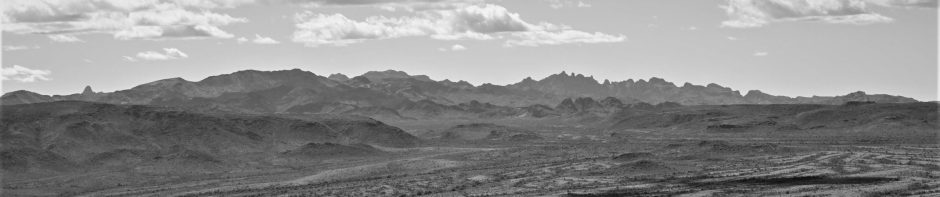
 I took a hike into the Palo Verde Mountain Wilderness as well. The desert preserves everything a long time. Even though it has been forever since people have been allowed to drive in this area, you could still see old tracks here and there in the desert. The hike I picked did not have much for human tracks – I left a clear track of one down a long stretch of desert gravel. I was headed down a wash cutting through the Mule Mountains. From my camp, I could see the gap looking down into the
  Cibola Valley. I had to be a bit cautious with how far I went as the trip was almost all downhill on the way in, and the heat was starting to pick up in late February. That meant coming back uphill in the heat of the day. It’s easy to get caught up in all the rock forms and trying to get far enough out of the mountains to see the valley below. I certainly had a harder trip back. Fortunately, the sun was starting to angle down enough that I could find some shade in the canyon parts of the wash. But still, the last climb back up onto the plateau was tough. Then I see my rig ahead of me, still a good mile away. At that point, I was done trudging through the desert, but there is no skip option when you are hiking in the real world.
 I did find one unusual human made thing out in the desert. In between me and Coon Hollow Campground was a road branch leading to a turn around area with a bit stuff stored in it, from the campground I presume. I was looking at a strange square frame made of rail road rails and angle iron, with a chain attached to it. It wasn’t until I turned and looked back at what it had dragged out that I see that this is a poor man’s grader. Clever, but I wonder if it can grab and bounce into the vehicle dragging it? I’ve seen another version of poor man’s grader when I was in Midlands area; a front end loader was dragging a large tire behind it to smooth the road down a bit.
 I had a good week out there. The weather was warming up just enough that I was comfortable without being too hot, other than during a tough day hike. But the heat was just going to increase: it was time to start heading north following the (hopefully) nice spring weather. Join me next time wherever I end up starting north again!